Website vs. Funnel: Which One Do You Really Need in 2026?
The Great Debate – Website or Funnel?
Small business owners are asking this more than ever:
"Do I need a website or a funnel? Which one will actually generate leads and sales?"
The answer is not a simple yes or no—it depends on your business goals, audience, and sales process.
In 2026, with all the automation, AI tools, and integrated platforms available (like GHL), making the wrong choice can cost you time, money, and leads.
This article will provide a data-driven, tactical guide to help you decide:
What a website actually does for your business
What a sales funnel actually does
Pros and cons of each for 2026 small business growth
How to decide based on your goals
Case studies and real examples
How to integrate GHL for websites and funnels
Conversion-focused tactics
Actionable CTA
By the end, you’ll have a clear roadmap to make the right investment and start generating leads more effectively.
1. What a Website Really Does in 2026
A website is more than a digital brochure. When done right, it:
Represents your brand: Colors, messaging, logo, positioning
Communicates your value: Homepage, about page, service pages
Provides social proof: Testimonials, case studies, awards
Acts as a resource hub: Blog posts, guides, downloadable content
Supports SEO: Helps prospects find you on Google
Collects leads (if optimized): Forms, lead magnets, email capture
Pros of a Website
Central hub for your brand
Builds credibility and trust
Search engine discoverable
Can support multiple services/products
Long-term content asset
Cons of a Website
Conversion rate often lower without funnels
Requires consistent traffic generation
Can be overwhelming for visitors if not streamlined
Design, development, and maintenance costs
Key takeaway: A website is great for credibility, information, and authority, but often underperforms in immediate conversions without funnel strategies.
2. What a Sales Funnel Really Does
A sales funnel is a step-by-step journey designed to convert a specific audience into paying clients.
Funnel structure usually includes:
Landing Page / Offer Page – Introduce one core offer
Lead Capture / Opt-In – Collect email or phone number
Follow-Up Sequence – Email/SMS automation for nurturing
Sales / Conversion Page – Present core product or service
Upsells / Downsell – Increase revenue per client
Delivery / Onboarding Page – Smooth client onboarding
Pros of a Funnel
Designed for high conversion
Focused on one goal per funnel (lead or sale)
Easy to track and optimize using analytics
Integrates with CRM + automation (like GHL)
Can be built quickly and scaled
Cons of a Funnel
Limited information for prospects seeking broader knowledge
Not ideal for multi-service businesses without separate funnels
Less SEO value long-term compared to a full website
Key takeaway: Funnels are ideal for direct conversions and automation, whereas websites are better for authority, branding, and multi-service education.
3. Data-Driven Comparison: Website vs Funnel
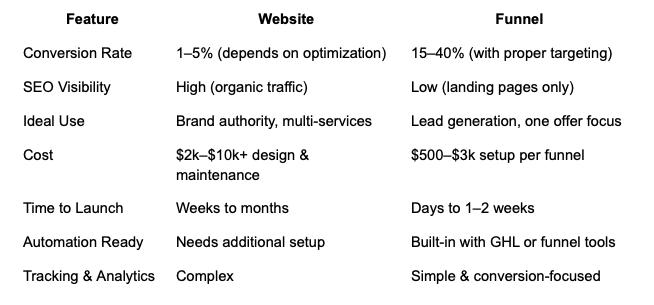
Insight: If your goal is quick lead generation and sales, funnels outperform websites.
If your goal is long-term branding, SEO, and authority, a website is necessary.
4. How to Decide Which One You Need
Step 1: Define Your Goal
Goal: Educate + Build Brand → Website
Goal: Generate Leads + Sales Quickly → Funnel
Step 2: Assess Your Offer
One signature offer → Funnel works best
Multiple services/products → Website as hub, funnels as conversion tools
Step 3: Evaluate Traffic Sources
Organic search → Website SEO critical
Paid ads → Funnel conversion-centric
Step 4: Consider Budget & Time
Limited budget → Funnel first, then expand into website
Long-term investment → Website + Funnels integrated
Step 5: Hybrid Approach (Recommended for 2026)
Website as brand hub + content
Funnels for high-converting campaigns
Integrated in GHL to track leads, sales, and automations in one system
Pro Tip: Don’t view this as an either/or. The most successful small businesses combine both strategically.
5. Common Misconceptions
“I only need a website” → Without funnels, conversions stay low
“Funnels replace websites” → Funnels are tactical, not strategic brand hubs
“I can DIY without a system” → Leads often drop off without automated follow-up
“Funnels are too complicated” → With GHL, templates + automation make it simple
6. Conversion-Focused Funnel Tactics for Small Businesses
Even if you have a website, integrating funnel strategies dramatically increases sales:
Lead Magnet + Opt-In: Free checklist, guide, or mini-course
Follow-Up Automation: Email + SMS to nurture leads automatically
Booking CTA: One-click appointment scheduling
Upsell / Cross-Sell: Offer related services or add-ons
Social Proof: Testimonials, results, case studies
Exit-Intent Popups: Capture abandoning visitors
Funnels make your sales predictable, while websites mostly inform.
7. Integrating GHL for Websites and Funnels
GHL is perfect for building both websites and funnels without juggling multiple tools:
Drag-and-drop website + landing page builder
Pipeline + CRM for leads
SMS + email automation for nurture
Booking + payment integration
Analytics for optimization
Example Workflow:
Visitor lands on website → clicks “Book a Consultation” → added to pipeline
Automated nurture sequence → 3-day follow-up emails
SMS reminder → 24 hours before call
Post-call → automated onboarding workflow
This ensures maximum conversion and keeps your business running efficiently.
8. Case Studies & Real-World Examples
Case Study 1: Service-Based Business
Website only → 1–2 consultations/week
Funnel added → 10+ consultations/week
Combined strategy → 30% revenue increase in 60 days
Case Study 2: Coaching Business
Funnel-only launch → sold out program in 2 weeks
Integrated website + funnel → improved trust, long-term client retention
Lesson: Funnels drive immediate sales. Websites build credibility for long-term growth.
9. Actionable Steps to Decide
Audit current website and funnels → what’s converting?
Identify your primary revenue driver
Decide which asset is priority this quarter
Implement hybrid strategy → website as hub, funnel for conversion
Track results with GHL analytics → refine monthly
10. Conclusion: The Smart Approach for 2026
In 2026, the smartest small businesses stop thinking in silos:
Use a website for brand authority, content, and SEO
Use funnels for high-converting offers and predictable revenue
Integrate both in GHL to simplify operations, automate follow-up, and scale efficiently
Your website informs. Your funnel converts. Combined, they make your business unstoppable.
Get a Website/Funnel Recommendation Call
Not sure whether you should invest in a website, funnel, or both?
BBI Consultants will:
Audit your current digital presence
Provide a data-driven recommendation for 2026
Map out the strategy to generate more leads and sales efficiently


